

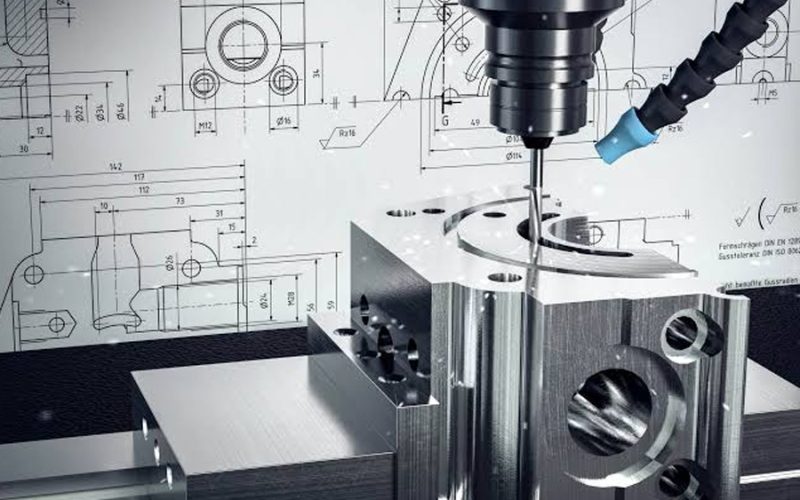
When choosing a metal for precision manufacturing, understanding its machinability is critical to controlling production costs and timeline efficiency. While brass is considered the industry gold standard for high-speed CNC milling in Archerfield, QLD, stainless steel presents a rigorous set of mechanical challenges that demand advanced technical expertise.
For engineers and product designers, navigating the trade-offs between these two popular materials comes down to understanding how they behave under the cutting tool.
Stainless Steel
Stainless steel alloys, such as grades 304 and 316, are favoured for their incredible strength and corrosion resistance. However, those exact properties make them notoriously difficult to machine.
- Rapid Work Hardening – Stainless steel hardens instantly under mechanical stress. If a cutting tool rubs or dwells for even a second, the surface becomes glass-hard, instantly destroying the tool edge.
- Severe Heat Concentration – Unlike other metals, stainless steel has poor thermal conductivity. Frictional heat does not escape through the chips and instead concentrates entirely at the tool tip, causing rapid thermal wear.
- Stringy Chip Management – The high ductility of stainless steel creates long, continuous, ribbon-like chips. A phenomenon known as bird-nesting, these can wrap around the spindle and ruin the part’s surface finish.
Brass Material
On the other end of the spectrum, free-cutting brass, or more popularly known as C36000, is engineered for efficient manufacturing.
- High-Speed Machinability – Brass requires significantly lower cutting forces, allowing CNC machines to run at maximum spindle speeds.
- Self-Breaking Chips – Brass naturally fractures into tiny, brittle chips that evacuate the cutting zone seamlessly without clogging the machinery.
- Extended Tool Life – Because brass dissipates heat efficiently and has abrasive hardness, cutting tools last up to four times longer compared to stainless steel runs.
Balancing Material and Production Costs
While raw brass often carries a higher upfront material cost than stainless steel, it frequently yields a lower total cost per part in high-volume production. This is driven by 50% shorter cycle times, minimal tool replacement costs, and exceptionally low reject rates.
However, when an application demands extreme tensile strength or chemical resistance, stainless steel remains irreplaceable despite its production hurdles.
Partner with RAHI Engineering Australia
At RAHI Engineering Australia, we combine state-of-the-art multi-axis CNC turning in Brisbane, QLD, with decades of technical expertise to deliver flawless components on time, every time. We optimise feeds, speeds, and custom tooling geometries to overcome the toughest material challenges, minimising your production costs without compromising quality.
Contact us to discuss your project specifications or request a comprehensive engineering quote.
